
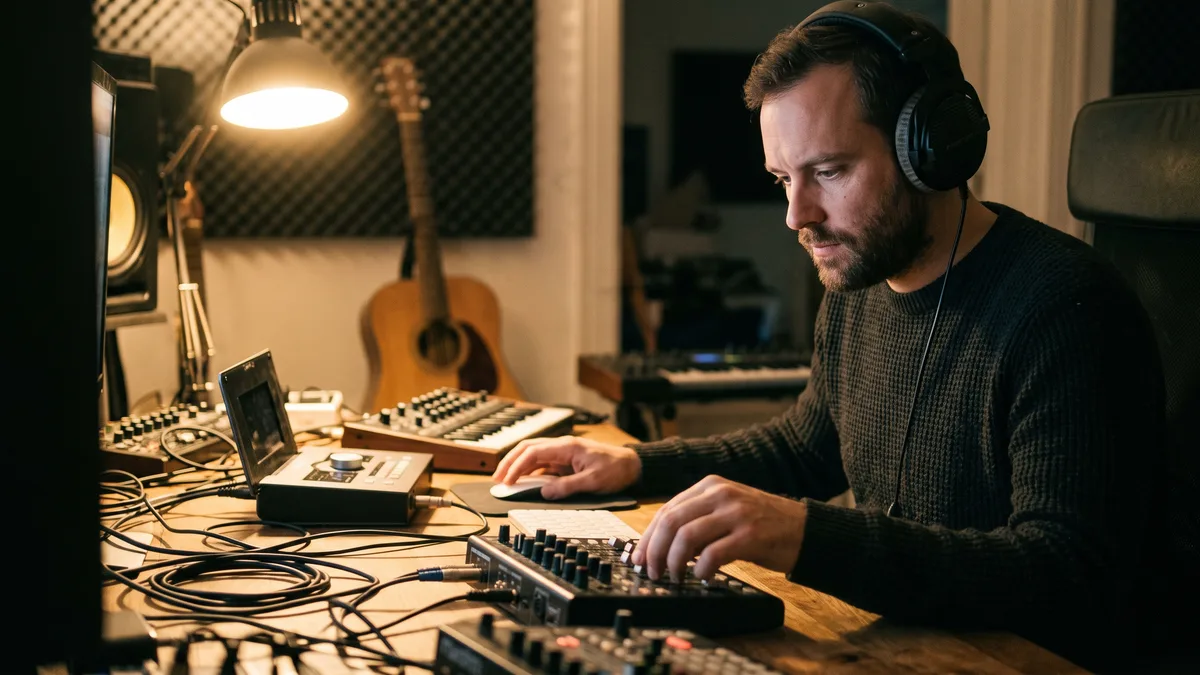
Custom songs are made in five steps: you share your story in a short form, the lyrics are written from your details, a person checks them against your brief, the music is produced in the genre and vocal style you picked, and the finished song arrives by e-mail as a studio-quality MP3. The form takes about 5–10 minutes. Standard delivery is within 2 business days, with a 24-hour express option when the date is close. What people underestimate is where the quality comes from: much more from the brief than from any studio gear. The names, memories and small habits you write down become the lines of the song. At Joyla every song also includes one free revision within 14 days of delivery. Below you'll find each step in order, what makes lyrics feel personal, a realistic timeline for planning around a date, and what you receive at the end.
What are the steps to make a custom song?
Here is the whole journey, from opening the form to pressing play:
- You fill in a short form. It takes about 5–10 minutes. You name the person and the occasion, describe a few memories and the feeling you want the song to carry, then pick a genre and a vocal style.
- The lyrics are written from your details. Your names, places and moments are shaped into verses and a chorus, so the raw material is always your story.
- A person checks the lyrics against your brief. Names, facts and tone are compared with what you wrote, and a detail that drifted gets caught before any music exists.
- The song is produced. The lyrics are set to music in the genre and vocal style you chose, with the arrangement built around the chorus.
- The MP3 arrives by e-mail. Standard delivery is within 2 business days, or within 24 hours with express. If something should change, one free revision is included within 14 days.
Your part ends after step one, and that's exactly why step one decides so much.
What happens to your story first?
Your brief gets read for raw material: names and nicknames, the memories you described, the occasion, and the feeling you asked the chorus to carry. The strongest details get promoted. A line like "she drove four hours in the rain" is lyric gold, while "she is kind and caring" gives a writer almost nothing.
That's why the form asks for moments rather than adjectives, and why what you say in your brief matters more than anything else in this article. The story is then mapped onto a song structure: which detail opens the first verse, which feeling anchors the chorus, where the name lands.
A song runs only a few minutes, so this stage is mostly choosing. Two or three details carried fully beat ten details mentioned in passing.
What makes the lyrics feel personal?
Specific details that only your circle would recognize. A listener can tell within one line whether a song was written about them or about "someone like them." Compare what different briefs give the writer:
| The brief says | What the song can do with it |
|---|---|
| "She's a great grandma." | Very little, because any grandma fits that line. |
| "Grandma Rose makes pierogi every Christmas Eve and still won't share the recipe." | A verse with her name, a kitchen, a season and a family joke. |
| "He's growing up so fast." | A generic chorus about time passing. |
| "Leo still asks for the same bedtime story, the one about the brave green tractor." | A refrain the whole family will recognize. |
| "Happy birthday to my best friend." | A birthday song that fits anyone. |
| "Maya turns 30. We met at 19 in a dorm laundry room, and she still folds my shirts wrong on purpose." | A birthday song for exactly one person. |
The pattern holds for every recipient. A custom song for grandma works when it names her rituals, and a custom song for your son lands when it carries his words, his nickname and the small moments you don't want to forget. The same goes for a custom birthday song: one story from the years before matters more than the number on the cake.
Three more things help: the nickname you actually use, a phonetic spelling for any unusual name, and one sentence about how you want the person to feel.
How do the lyrics become music?
The genre and vocal style you picked set the blueprint. An acoustic ballad phrases a chorus differently than a country track or a rock anthem, and a soft voice carries a tender line differently than a bright pop vocal. The melody is shaped so the key line, usually the name or the promise, lands on the note people remember.
The arrangement is built around that moment, with instruments, tempo and dynamics rising toward the chorus. This is also where pronunciation gets handled. Names are the most important word in the song, so if yours is unusual, spell it the way it sounds.
Pick the style the recipient loves, even if you'd stream something else yourself. A country fan hears a country song as "theirs" before the first verse ends.
Who checks the song before delivery?
A person, with your brief open. The check looks for the things that break the spell: a misspelled or mispronounced name, a detail that drifted from what you wrote, a chorus that buries the point. Lyrics are reviewed before production, and the finished track is checked before it's sent.
The first lyric draft is written with AI assistance from your brief, and this human step is what keeps it faithful to your story. It's also a fair question to ask any service: price comparisons mean little until you know whether a person reviews the output.
No review can catch how a song feels to you, though. That's what the free revision is for: within 14 days of delivery you can ask for a name to sound different or a line to shift, and you receive an updated version.
How long does it take to make a custom song?
Standard delivery is within 2 business days of your order, and express delivery is within 24 hours. The clock covers the whole journey: lyrics, the human check, production and the final listen. Services that promise "instant" songs usually skip at least one of those steps, which is why their songs tend to sound like templates.
A realistic timeline for a standard order looks like this:
| When | What happens |
|---|---|
| Day 0 | You fill in the form (5–10 minutes) and place the order |
| Within 2 business days | The MP3 arrives by e-mail |
| Up to 14 days after delivery | You can request your one free revision |
| The big day | You play it, send it, or hand it over with the gift |
Count business days, so weekends don't eat into your plan. For a fixed date like a Father's Day song, ordering about a week ahead is the comfortable option: it leaves time to listen, use the revision if you need it, and still have the final version ready. If the date is tomorrow, express plus a focused brief is the reliable combination.
What do you get at the end?
A finished, studio-quality MP3 delivered by e-mail. It's a download you keep forever rather than a stream or an expiring link, and there's nothing to ship. You can play it at the party, send it to the person, or set it under a photo slideshow.
People present it in different ways. Some play it at the dinner table without warning, others send it with a short note, and some build a playlist of shared favorites with the new song as track one (we compared both gifts in custom song vs playlist).
From there it stops being a production process and becomes what it was ordered to be: the moment someone hears their own name in a chorus and realizes the song is about them. If you have a story ready, you can start your custom song here.