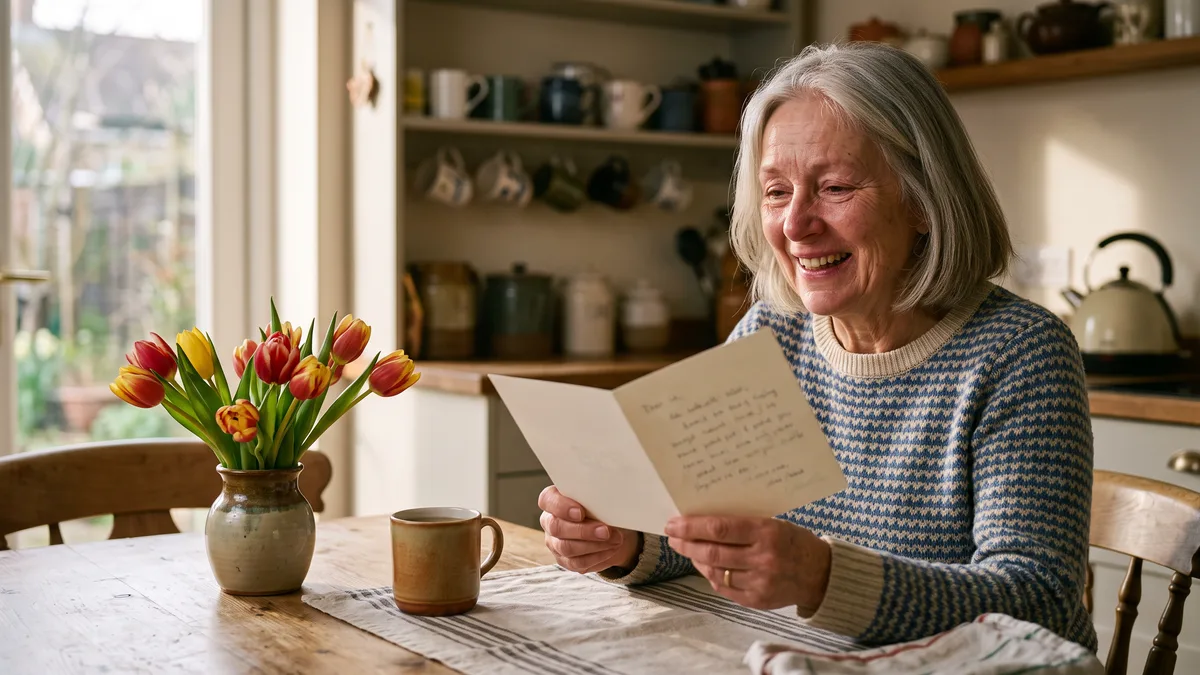

A retirement wish for a coworker lands when it names the person, not the milestone: what they were like to work beside, one thing they made easier, and a genuine send-off into whatever comes next. Below you'll find more than fifty ready-to-use messages sorted by tone — heartfelt, funny, and short — plus short messages for a colleague you'll text or email, separate sections for a retiring boss, a colleague you barely knew, and the group card that's been circling the office all week.
You'll also get a three-part formula for making any of them sound like you, and a short list of what to leave out (age, health, and money top it). At Joyla we turn workplace send-offs into personalized songs, and the ones that move a room always share one detail: something only that team would know. Start from the detail, and the rest of the message writes itself.
What do you say to a coworker who is retiring?
Three parts, in this order: name their role in your working life, point to one specific thing they did, then send them into what's next.
Generic version: "Happy retirement, you'll be missed!" Specific version: "Twelve years of you catching my mistakes before the client did. I have no idea how Thursday reports survive without you. Enjoy every slow morning."
The middle part carries the whole message. A shift they covered, a habit the whole team copied, the phrase they said in every meeting, the fact that they trained half the floor. One small true thing, and the card stops sounding like it came off the drugstore rack.
Then match the warmth to the relationship. A desk neighbour of nine years gets a paragraph; someone from the third floor gets two warm sentences. Both are correct — overclaiming closeness is the most common mistake in a retirement card.
Heartfelt retirement wishes for a coworker you worked with daily
These are for the person whose absence you'll notice on day one. Swap in your own detail — a project, a habit, a running favour — and any of them stops being a template.
- Working next to you set the standard for everyone who comes after. Thank you for showing us how it's done, day after day.
- You made a hard job feel manageable just by being in the room. I'll miss that more than fits on a card.
- Thank you for every question you answered patiently, especially the ones I should have known the answer to.
- You leave behind a team that knows what it's doing because you took the time to teach us. That's a real legacy.
- Some people do the work. You looked after the people doing the work. Thank you for that.
- I learned more from watching how you handled the difficult days than from any training I've ever sat through.
- You were the calm one in every crisis. Go be calm somewhere with a much better view.
- Congratulations on a career that left this place better than you found it. Enjoy every minute of what comes next.
- Thank you for treating the newest person in the room exactly like everyone else. Not everyone does that.
- It has been a genuine privilege to call you a colleague. I hope retirement is as generous to you as you were to all of us.
- You gave this company decades of your mornings. Take every one of them back.
- The best part of my day was usually a conversation with you. Please stay in touch — I mean it.
Funny retirement wishes for a coworker that stay office-appropriate
Humour works when it teases the job, never the person. Skip anything about age, decline, or naps; aim at meetings, inboxes, and the office kitchen instead.
- Congratulations, every day is Saturday now. Try not to gloat too loudly in the group chat.
- You're leaving us alone with the printer. That's the part I can't forgive.
- Retirement rule number one: when we call about the password, you have to pretend you've forgotten it.
- Enjoy the part where nobody ever schedules anything at 8 a.m. again.
- We'd say this place won't run without you, but we're about to find out live.
- Congratulations on your permanent out-of-office reply. It's the finest one you'll ever write.
- You've earned a life with zero status updates. Go enjoy it while we keep providing them.
- Happy retirement! Please think of us when you're describing your Tuesday to someone at 11 a.m.
- Thank you for years of loyal service and for never once telling anyone what was in that fridge.
- Somewhere out there is a hobby that has no idea what's about to happen to it.
- We're not crying. We're just already dreading the next team meeting without you.
- Your inbox is officially somebody else's problem. Sit with that feeling for a while.
Short retirement messages for a colleague
Not every goodbye goes on the group card. For a text on their last day, a reply to the farewell email, a LinkedIn comment or a sticky note on their monitor, keep it under fifteen words and make it about them.
- Happy retirement! The office just got a lot quieter, and a little worse.
- Thank you for being the colleague everyone hoped to be paired with.
- Congratulations! Go enjoy every Monday morning you no longer owe anyone.
- Wishing you long lunches and zero calendar invites from here on.
- Working with you made the hard weeks easier. Thank you, and congratulations.
- You taught me half of what I know here. Enjoy retirement.
- Happy retirement to the colleague who always had time for one more question.
- Congratulations! Keep in touch, and send pictures of whatever you do next.
- Your desk is empty, but your habits live on in this team. Happy retirement.
- Congratulations on a great career. It was a pleasure working beside you.
Short retirement messages for a card everyone has to sign
When forty people share one card, you get two lines. Short doesn't mean generic — name one thing and stop.
- Happy retirement. You earned every single day of it.
- Thank you for years of doing this the right way.
- This place won't sound the same without you.
- Congratulations. Go enjoy the slow mornings.
- Genuinely grateful I got to work with you.
- The best colleague I've had. Simple as that.
- Onward to better coffee and shorter meetings.
- You'll be missed here. Every day.
- Thank you for making the work feel worth it.
- Wishing you a retirement as good as you were to work with.
- Cheers to you and to whatever comes next.
- It won't be the same. Congratulations anyway.
If the card is circulating for a big send-off, agree on a theme before it goes around — one memory each, or one thing you learned from them. It reads far better than forty variations of "all the best".
What do you write for a retiring boss or mentor?
For a manager, gratitude beats jokes. Name what their leadership actually did for you, keep it professional enough to be read aloud, and don't assume you were their favourite.
- Thank you for backing me in rooms I wasn't in. I know that happened more often than you ever mentioned.
- You led by example long before you told anyone what to do. I'll carry that with me.
- The bar you set is the one I still use. Enjoy a retirement you very much earned.
- Thank you for the feedback I didn't want to hear and needed to. It changed how I work.
- You built a team that will keep doing this well after you've gone. Congratulations on a career that mattered.
- Thank you for taking a chance on me when my résumé didn't obviously deserve it.
- Wishing you a retirement full of everything work kept postponing.
- Congratulations on decades of leading decently. That's rarer than it should be.
What do you say to a coworker you barely knew?
Warm and brief is the whole brief. Don't invent shared memories — a sincere two-line wish reads better than a fake anecdote.
- Congratulations on your retirement. Wishing you a wonderful next chapter.
- It's been good having you on the floor. Enjoy everything that comes next.
- Happy retirement! Your reputation around here is a good one — enjoy the rest.
- Wishing you health, time, and a long stretch of good days.
- Congratulations on a long career, and thank you for everything you gave this team.
- Best wishes for a happy retirement from all of us over in operations.
- Enjoy the freedom. You've absolutely earned it.
- Congratulations! All the best in whatever you do next.
What should you not write in a retirement card?
A few things reliably land badly, however well meant:
- Age jokes. "Finally putting the old horse out to pasture" is funny to exactly one person, and it isn't the retiree.
- Health remarks. Wishing someone good health is kind; speculating about it is not.
- Money and pensions. Never guess at someone's finances, and don't joke about whether they can afford to retire.
- Reasons you don't know. Some retirements aren't entirely voluntary. Congratulate the career, not the decision.
- Inside jokes on a shared card. If only two of you get it, save it for a separate note.
- Work requests. "Call me if you ever fancy consulting" is a task, not a send-off.
- Complaints. "Lucky you, I'm stuck here for another twenty years" makes their moment about you.
How do you make a retirement message personal?
Use the same three-step method for a card, a speech, or a gift tag:
- Pick one moment. The night before the audit, their first week, the day they fixed something nobody else could.
- Say what it showed about them. Patience, nerve, generosity — name the trait the moment proves.
- Point it forward. Connect it to what they're heading into: the garden, the grandchildren, the boat, the finally-empty calendar.
That's it. If you're stuck, the prompts in our guide to what to say in a personalized message or song work just as well on a retirement card as they do on lyrics — they're all about pulling out concrete detail instead of adjectives.
The same logic scales up to gifts. A framed photo works because of the moment it captures, not the frame; a personalized song works because of the stories you feed into it, not the genre.
What if a card isn't enough for the whole team?
Sometimes one signature line each can't hold thirty years. When the team wants to give something together, a group gift solves the maths problem — everyone chips in, and the retiree gets one thing instead of eleven mugs.
A retirement song for a coworker is a version of that group card you can actually play at the party. You submit the details in a short form — the department, the running jokes, the project everyone survived, the names of the people signing — and the finished song comes back as a studio-quality MP3 by e-mail, usually within two business days, with one free revision if a detail needs fixing.
For a colleague who genuinely became a friend over the years, the same idea works as a song for a best friend — less career retrospective, more the two decades of lunches.
Whichever route you take, write the card anyway. The song plays once at the party; the card sits on their shelf, in your handwriting, with the one true detail you almost didn't bother to include.