The Christmas traditions worth starting are the ones that leave something behind — a box, a book, a recording, a line of handwriting with a year on it. Anything can be fun for one December; a tradition earns its place when your family notices it missing. Below are 22 ideas sorted by who you are spending Christmas with: little kids at home, grown kids calling from three time zones away, and the multigenerational years when everyone squeezes around one table.
You will also get a short method for making a new tradition survive its second year, which is where most of them quietly die. At Joyla we read the stories families send us when they turn a year into a song, and one phrase shows up constantly: "every Christmas we…" — followed by something small, specific and repeated. That is what you are building. Start one thing this year, keep it deliberately simple, and let it grow roots.
What Christmas traditions are worth starting?
Start with the ones that produce an artifact. A nice evening is a memory. A nice evening plus one thing written down, photographed or saved is a tradition with a paper trail — and the paper trail is what your kids will fight over one day.
- The dated ornament. Every December each person picks or makes one ornament and writes the year plus three words on the back. Two decades later, unpacking the box is the tradition.
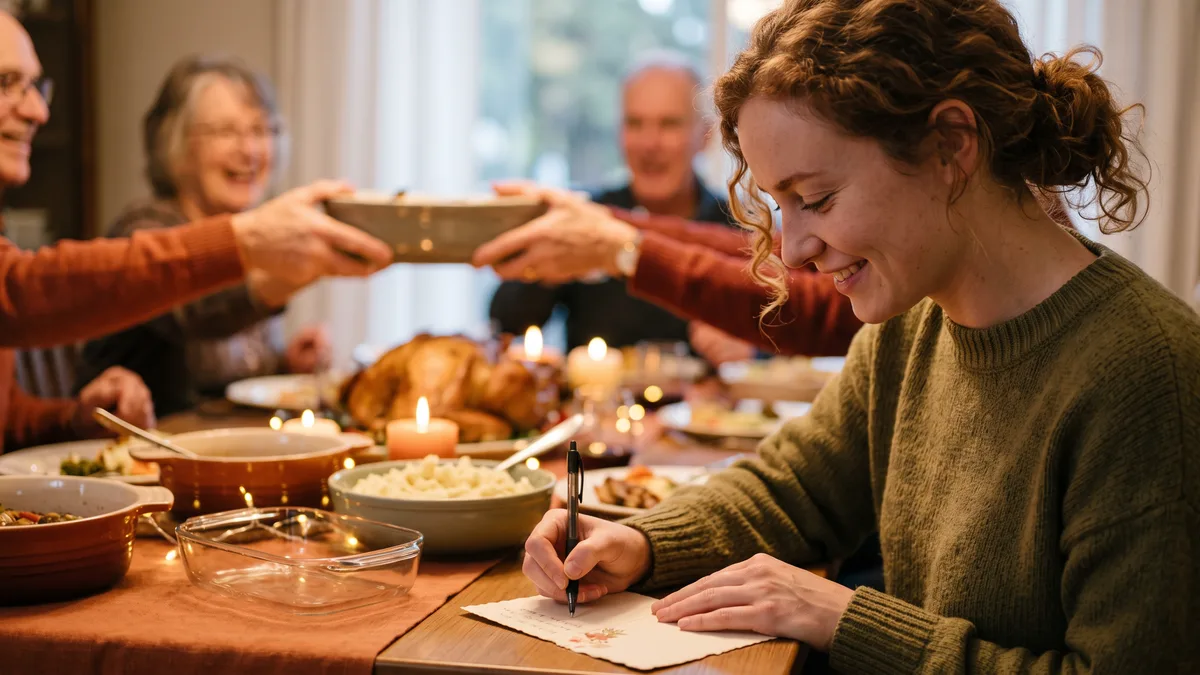
- The Christmas Eve letter box. Everyone writes a short letter to next year's version of the family: hopes, worries, running jokes. Seal them, and read last year's out loud before anyone writes a new one.
- The same-spot photo. One photo, same doorway, same order, every single year. The haircuts change, the doorway does not, and the sequence becomes the most valuable thing in the house.
- The candle pass. On Christmas Eve one candle goes around the room, and whoever holds it names a single moment from the year worth keeping. Ten minutes, no props, no shopping.
- The recipe book that never ends. Each Christmas one person adds a recipe in their own handwriting, with a note about who taught it to them. It gets better precisely because nobody finishes it.
- Jólabókaflóð. The Icelandic Christmas Eve custom: everyone exchanges books, then spends the evening reading with something chocolate. It is the rare tradition that makes the house quieter.
- The kindness envelopes. Twenty-four envelopes on the wall, one small act of kindness inside each. Kids open them instead of chocolate, and the idea ages well as they grow.
What Christmas traditions work with little kids?
Small children do not need elaborate, they need repeatable. Choose things a tired adult can still pull off on a Tuesday in December, because a tradition that depends on a good mood is not a tradition.
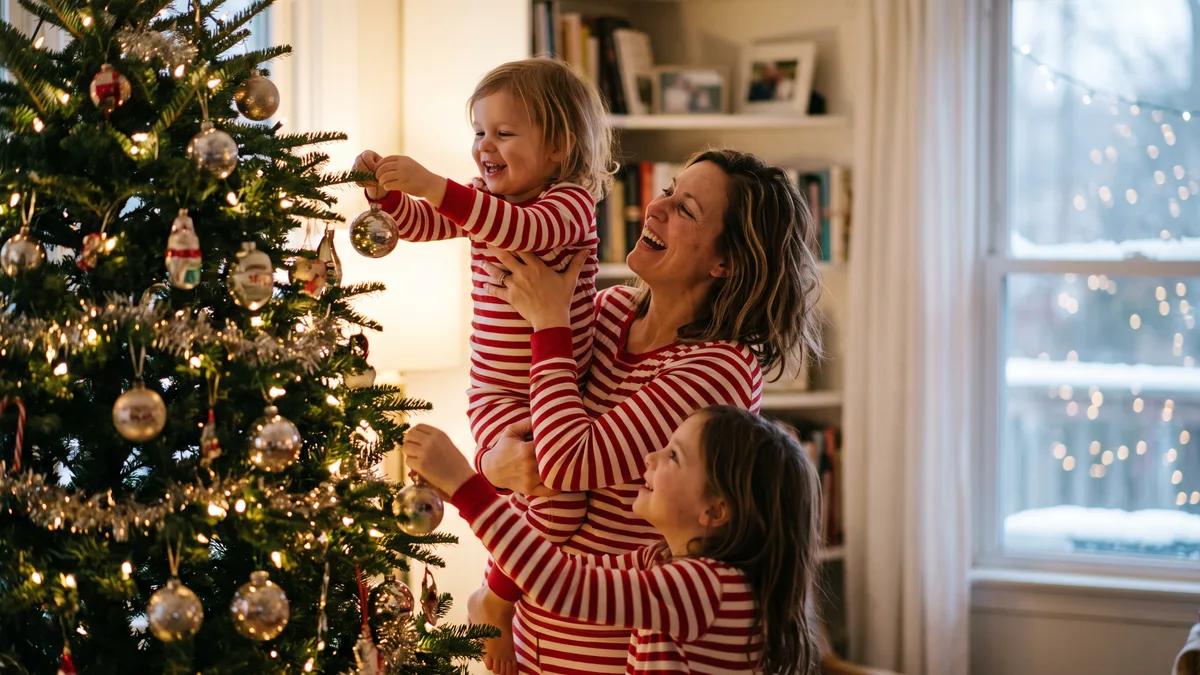
- Pajamas the night the tree goes up. New pajamas come out the evening the lights go on, not on Christmas Eve. It moves the magic to the start of the season instead of the end.
- The lights drive. Same route, hot chocolate in travel mugs, everyone in those pajamas. Toddlers who remember nothing else will remember this one.
- Painted cookies. Mix egg yolk with a drop of food colouring and let them paint sugar cookies before baking. Low mess by December standards, and the results are hilarious.
- The one-question interview. Film thirty seconds of each child answering the same question every year: "What was the best thing that happened to you?" The archive is worth more each December.
- The Christmas Eve film. One film, same one every year, non-negotiable and slightly too old for them. Familiarity is the entire point.
- The handprint year. A handprint ornament, or a pencil mark on the back of a door with the date. Growth is invisible day to day and obvious across ten Christmases.
What about grown kids, distance and the years nobody comes home?
Traditions usually break when the family scatters, which is exactly when they matter most. The fix is to move the ritual, not cancel it — the same principle behind the long-distance ideas in our guide to Thanksgiving traditions worth starting.
- The fixed call. Not "we'll call at some point" but a set hour on a set day, in the calendar, treated like a flight. Vagueness is what kills long-distance traditions.
- Same recipe, different kitchens. Everyone cooks the same family dish on the same evening and sends one photo of the result. Cooking together does not require the same room.
- The shared album. One album per year, everyone adds a handful of photos and a caption. Scroll it together on the call instead of scrambling for small talk.
- The box in the mail. Each household mails one small, specific thing — a photo, a note, a local sweet — timed to arrive before Christmas Eve and opened together on video.
- The synchronized listen. Press play on the same song or film at the same minute in different countries. It sounds silly, and it works, because the point is being in the same moment.
How do you build a tradition three generations can share?
The multigenerational Christmases are the finite ones. Build the traditions that record the oldest people in the room while they are still in it, because that is the part nobody can recreate later.
- The one-question recording. Every year, ask a grandparent one new question on camera: how they met, the worst Christmas they remember, what the house smelled like. Five minutes a year becomes an archive.
- The story dish. One dish per Christmas comes from an older generation, and whoever cooks it tells the story behind it before anyone eats. Recipes travel further when they carry a story.
- The ornament handover. Each grandchild gets one ornament a year, kept in a labelled box; when they move into their own place, the collection goes with them. The tradition transplants itself.
- The annual letter. Grandparents write one page a year to the whole family, read aloud after dinner and filed. Some families do the same in audio, and a few turn the year's material into a personalized song about their parents or a song for grandma that the grandchildren still play a decade later.
How do you make a new Christmas tradition stick?
- Start one, not seven. One new tradition per year, added to whatever survived last year. Families abandon whole holidays because they tried to reinvent December in a single go.
- Anchor it to a fixed moment. "After the tree is up," "before we open presents," "the first Sunday of December." Traditions attached to a time survive; traditions attached to a mood do not.
- Keep it under an hour and cheap. If it needs a budget, a babysitter or a clear schedule, it will not run for ten years. The ones that last are almost embarrassingly small.
- Give somebody the job. One named person is responsible for the candle, the album, the questions. Traditions do not die from disinterest, they die because everyone assumed someone else had it.
- Let it change and keep the name. The lights drive becomes the lights walk, the interview becomes a group call. Protect the ritual, not the logistics — and drop anything nobody misses when it lapses.
What if you want a tradition that outlasts the decorations?
Most of the ideas above leave a physical trace: a box of ornaments, a book of recipes, a shelf of letters. The other option is to give the year a soundtrack — one thing your family hears every December that could not have been made about anyone else.
That is what a custom Christmas song does. You share the names, the running jokes and the memories in a short form, choose the genre and vocal style, and a studio-quality MP3 arrives by e-mail — no shipping, and yours to keep and replay for good. Some families commission one every few years and treat the growing collection as the tradition itself.
Whichever route you take, do not wait for the year everything is calm enough to start properly. Traditions are not built in the perfect December. They are built in an ordinary one, by doing something small twice.