The best Thanksgiving traditions to start are the ones that make gratitude specific and keepable: rituals that get people saying real things about each other, then hold onto those words after the leftovers are gone. The dreaded "go around the table and say what you're thankful for" fails because it's unprompted and instantly forgotten. Give people a better question and somewhere for the answer to live, and the same moment becomes the highlight of the day.
Below are more than 20 traditions grouped by type: gratitude rituals, food and table traditions, ideas for family far away, traditions with kids, keepsakes that last for decades, and gentle ways to mark the first Thanksgiving after a loss.
Thanksgiving 2026 falls on Thursday, November 26, so there's still time to pick one and prepare it properly. At Joyla, many of the song stories we read start with "every Thanksgiving we…", because gratitude traditions tend to grow into a family's identity.
How do you choose a Thanksgiving tradition to start?
Pick by the problem you want to solve. If the gratitude round always feels forced, start at the table. If half the family lives in another state, start with the long-distance ideas. If you want something the grandchildren will inherit, start with a keepsake.
| Type | Best for | What it leaves behind |
|---|---|---|
| Gratitude rituals | Families who dread the go-around | Notes and cards |
| Food and table | Big gatherings with several cooks | Recipes and photos |
| Family far away | Split households, students, relatives abroad | Recordings and a shared album |
| With kids | Families with children under 12 | Placemats, drawings, interviews |
| Keepsake traditions | Anyone thinking in decades | A tablecloth, letters, a song |
| After a loss | The first year with an empty chair | A shared story |
One new tradition per year is plenty.
What are good gratitude rituals for the Thanksgiving table?
These replace the forced circle with something people actually enjoy answering:
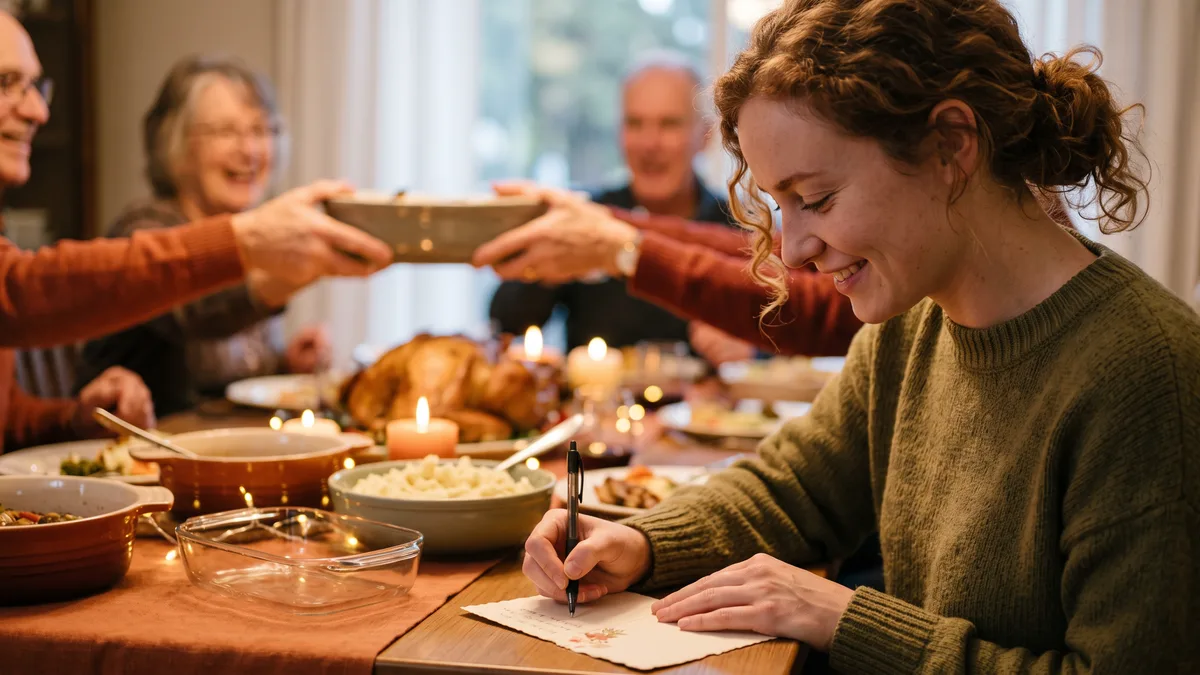
- The gratitude jar. From November 1, anyone drops in a note about anyone else. At dessert, read them aloud. Anonymous notes get the shy people participating.
- The aimed thank-you round. Each person thanks the person to their left for one specific thing from this year. Aim beats ambush.
- Question cards. Put a card under each plate with a better prompt: "Who helped you this year without knowing it?" or "What almost went wrong and didn't?"
- The absent-friend toast. One toast a year to someone who isn't at the table: a nurse on shift, a friend abroad, the neighbor who shoveled the driveway. Someone texts them afterward so they hear it.
Which food and table traditions are worth starting?
Food is already the center of the day, so these traditions cost almost no extra effort:
- The heritage dish. One recipe from a grandparent goes on the table every year, cooked by whoever is learning it. The original cook tells its story while it's served.
- The recipe card swap. Every cook brings a handwritten card for their dish. Keep them in one box, and in ten years you have the family cookbook.
- The new-dish slot. One spot on the menu is reserved for something nobody has made before. It keeps the menu alive and gives the teenagers a job.
- The morning walk. Same route, every year, any pace, before the cooking starts. Every busy day needs one calm anchor.
How do you celebrate Thanksgiving with family far away?
Distance changes the delivery, not the tradition:
- The fixed-time video toast. Pick one time that works across time zones and have every household raise a glass on the same call for ten minutes. Short beats a laptop left running at the end of the table for three hours.
- The shared album. Everyone adds one photo from their year with a caption of thanks, and you scroll it together on the call.
- The call list. Everyone at the table phones one person who isn't at any table this year.
- The recipe care package. Mail the dry ingredients and the recipe card for the family's signature dish, so the person far away cooks the same thing on the same day.
- The two-person feast. In small households, each person cooks the other's single favorite dish. A feast is defined by intention, not headcount.
The first Thanksgiving away from home hits students and new graduates hardest. If your son is spending the holiday on campus or in a new city, a voice memo from everyone at the table, or a custom song for your son built from family memories, makes the distance feel shorter for one evening.
What Thanksgiving traditions can you start with kids?
Kids make traditions stick because they remember and insist. Give them these:
- Handprint placemats with the year. Trace each child's hand on a paper placemat, date it and keep the stack. Ten years of growing hands laid out on one table beats any photo album.
- The thankful tree. Put a bare branch in a vase and cut out paper leaves. Every day in November, the kids add one thing they're grateful for, so the branch is full by Thanksgiving.
- Kid-run interviews. Hand the youngest a phone and three questions for the grandparents: "What was Thanksgiving like when you were my age?", "What's your favorite dish and why?" and "Who taught you to cook?"
- The table-setting crew. Kids own the table: name cards, centerpiece, napkin folding. A job turns waiting into belonging.
Those interviews tend to surface the best family stories. If Grandma's answers about her own childhood Thanksgivings make the whole room go quiet, save the recording. It's exactly the material a custom song for grandma is built from.
Which keepsake traditions last for decades?
Words said at a table evaporate. Keepsake traditions give them a body:
- The tablecloth archive. One fabric tablecloth and fabric markers: everyone writes one line and the year. Ten years in, it's the most valuable thing in the house.
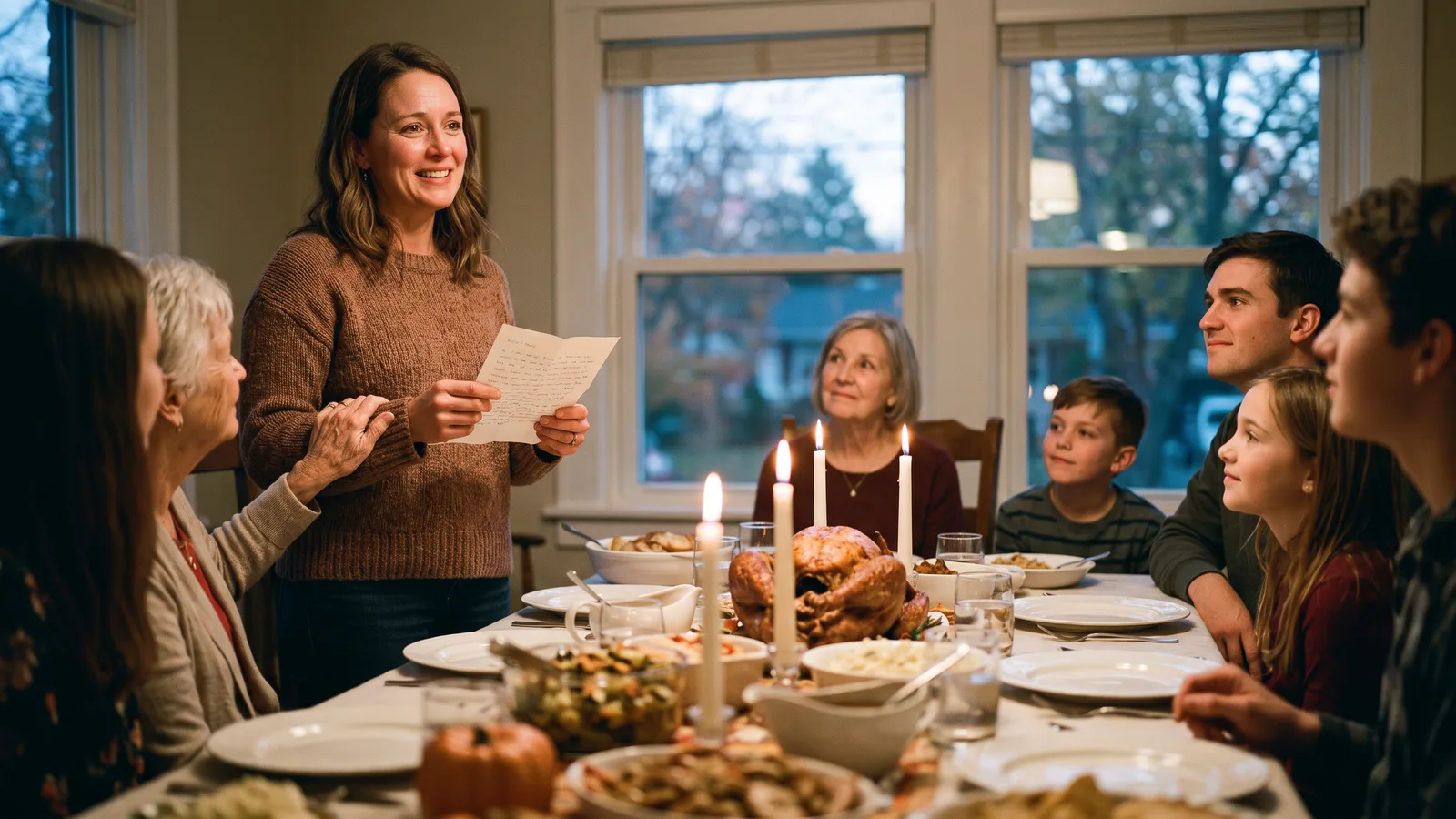
- A letter a year. One person writes a short letter to the family about the year that passed and reads it at dessert. The writer rotates every year.
- The recorded message. Film thirty seconds of each person answering the same question and cut it into a yearly reel. Watching the 2026 reel in 2036 is its own holiday.
- A song about the family. Take the family's answers about one person, the year everyone's notes point at Mom or Dad, and turn them into a custom song for mom or a custom song for dad built from the family's own words. Play it after dessert. (If writing the words is the obstacle, start with our thank-you messages for mom.)
Hosting is the least-thanked job of the holiday. If your sister has carried the turkey, the seating chart and the dishes for years, the table's notes about her could become a custom song for your sister instead of one more bottle of wine.
How do you celebrate the first Thanksgiving after a loss?
The first Thanksgiving after someone dies is less about new traditions and more about deciding which old ones to keep. Talk about it before the day, so nobody is caught off guard by an empty chair or by a table rearranged to hide it. A few gentle options families use:
- Cook their dish. Make the recipe they were known for and say whose it is when it's served.
- One story each. Before the meal, everyone shares one short memory. Short keeps it bearable, and anyone can pass.
- A candle at the table. A lit candle marks their place without anyone needing to find words.
- A different shape, on purpose. A different house, a restaurant or a smaller table is allowed. Grief often needs a new format for a year.
Some families also choose a lasting tribute: a framed recipe card, a donation in their name, or a memorial song written from the stories shared at the table and played when the family is ready. There is no deadline for any of it.
What can you say at the Thanksgiving table?
If you're asked to give a toast or say grace and the words won't come, borrow one of these and add a name or a detail:
- "I'm thankful for everyone who made it here today, and for the ones who couldn't, who are in every story we'll tell tonight."
- "This year taught me who shows up. Most of them are sitting at this table."
- "Thank you to the cooks, the dishwashers and whoever kept the kids out of the kitchen."
- "I'm grateful for the ordinary days this year, because we got so many of them together."
- "Grandma, thank you for this recipe and for every Thanksgiving you hosted before we understood how much work it was."
- "To everyone who helped me this year without knowing it: I know now, and thank you."
- "I'm thankful we still fit around one table, even if we need two extra chairs every year."
How do you get everyone to actually share gratitude?
Structure beats sincerity demands. Give a prompt ("one small thing from this year") and give it early: write cards before dinner, read them after, and let people read someone else's card instead of performing their own. Kids go first because they have no shame filter, and their answers loosen the adults. Keep one escape hatch: anyone can pass by putting their note in the jar unread. Participation rises when performance is optional.
What should you skip?
Over-programming. Three scheduled activities between dinner and pie turn gratitude into a workshop. Skip anything that requires a performance from your most private family member, skip the tradition nobody misses when it lapses, and keep the bar low enough to clear on the busiest cooking day of the year.
The traditions that survive are the ones that fit inside the day you already have. If you want a bigger gesture some year, a song made from the family's words is one planned surprise that doesn't add a single dish to the schedule.