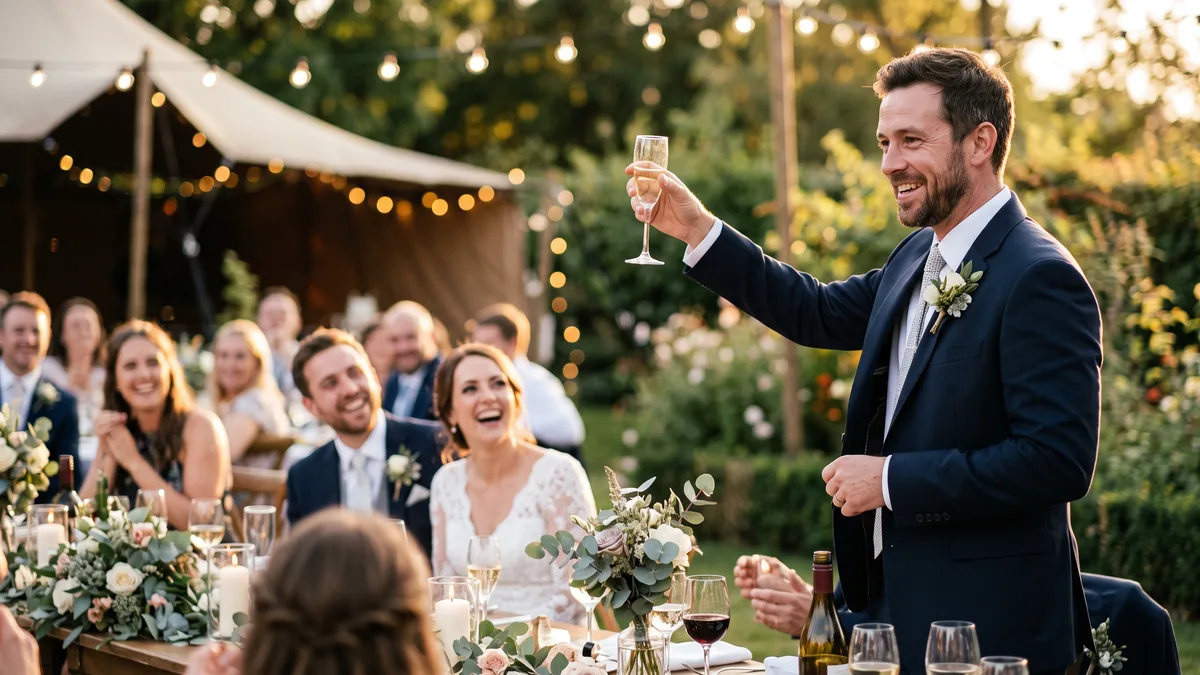
The best wedding toast examples all follow the same four beats: open with a line that earns attention, tell one specific story, say what you wish for the couple, then raise your glass. No poetry required. Below you'll find toasts written for every role at the reception — best man, maid of honor, parent, sibling, and friend — and in every tone, from thirty-second one-liners to funny and heartfelt. You'll also get the timing rules wedding pros agree on and the lines that quietly sink a speech. And one ending almost nobody uses: instead of closing with a borrowed quote, some guests finish by playing a song written for the couple, pooled as a group gift from the table. At Joyla we hear about those moments often, and the reaction in the room is never subtle.
What is the simplest structure for a wedding toast?
Every toast that works — funny, tearful, thirty seconds or three minutes — runs on four beats: hook, story, wish, raise.
- Hook. One or two sentences that make the room look up. Your name and role can wait until sentence three.
- Story. One specific moment that shows who the couple is. One. Not a highlight reel.
- Wish. What that story tells you about their marriage, and what you want for them.
- Raise. A single clear line telling guests to lift their glasses. Never skip it — without it, nobody knows when to drink.
Write the four beats as four empty bullets first, then fill them in. That order also explains why long toasts feel lost: a rambling speech is usually beat two, repeated four times.
How long should a wedding toast be?
Two to three minutes. Wedding pros are consistent about the ceiling — planning guides from The Knot and Zola both put it around five minutes, and most receptions run several speakers back to back.
Write to a word count instead of a clock. Roughly 300 to 400 written words comes out as two to three spoken minutes once you add pauses and laughter. Print it, read it aloud with a timer, and cut every sentence that isn't the hook, the story, the wish, or the raise.
If you're the fourth person to speak, halve it. No one in the history of weddings has complained that a toast was too short.
How do you start a wedding toast?
Not with "for those of you who don't know me." Open with a line that earns attention, then slide your name and role into the second or third sentence, where it costs you nothing.
Three openers that reliably work:
- The first impression. "The first time [Groom] mentioned [Bride], he forgot what he was saying halfway through the sentence. That was three years ago. It still happens."
- The confession. "I've known [Bride] since we were eleven, and I have never once seen her this calm before something important."
- The story already moving. "It's two in the morning, we're stranded at a gas station outside [City], and [Name] is the only one laughing."
Then land the introduction: "For anyone we haven't met — I'm [Name], the bride's sister."
Wedding toast examples for every role
Treat these as scaffolding. Keep the shape, swap in your own detail: a borrowed structure with your story sounds original, a borrowed story never does.
Best man toast
"I met [Groom] our first week of college, when he knocked on my door to ask if I owned an iron. I did not. Neither did he, and we've been figuring things out together ever since. Here's what I know about him: he says almost nothing about the things that matter most. So when he called me about [Bride] and talked for forty minutes, I understood immediately. [Bride], thank you for making my friend that talkative. Everyone — glasses up."
Maid of honor toast
"[Bride] has spent her whole life being the person everyone calls first. The one who shows up with soup, a spare charger, and the exact right sentence. Watching her meet someone who does all of that back has been the best surprise of the last few years. [Groom], you noticed her fast, and you have never once made her feel like too much. That's all any of us wanted for her. To [Bride] and [Groom]."
Parent's toast
"When our daughter was small, she narrated everything — the drive to school, the weather, the dog's opinions. We used to say she could talk the ears off a statue. Today she's marrying the one person who never wanted her quieter. [Partner], welcome; you fit here. To the two of them, and the life they're building."
Parents often have more material than a microphone allows. Some turn the overflow into a song written for their daughter and play it right after the toast instead of stretching the speech.
Sibling toast
"Growing up, my sister and I shared a wall, so I heard every phone call she ever made. I want everyone to know I have decades of material and I'm using none of it. Here's the only part worth saying: she has always been braver than me. Marrying someone who makes her braver still is exactly how this was supposed to go. To [Bride] and [Groom]."
Friend or guest toast
"[Name] and I have been friends through four apartments, two career changes, and one truly regrettable haircut. Somewhere in the middle of all that, [Partner] showed up — and my friend got calmer, funnier, more himself. That's the whole test, isn't it? To the couple."
If a minute at the microphone doesn't cover it, a group of friends can put the rest into a song made for a best friend rather than a second speech nobody scheduled.
Short, funny, and heartfelt toast examples
Short toasts, under thirty seconds
- "To [Bride] and [Groom] — who make being in love look easy and being kind look like a habit. Cheers."
- "I've never seen two people better at being on the same team. The rest of us should take notes. To the newlyweds."
- "May your worst days be brief and your inside jokes be endless. Glasses up."
- "Some people find their person. These two found theirs and then built a home out of it."
Funny toasts
Humor lands when it's affectionate and aimed at yourself, or at something the couple already laughs about.
- "I was asked to keep this short, clean, and free of anything that happened before 2021. So this will be very short."
- "[Groom] told me the secret to a happy marriage is admitting when you're wrong. He also mentioned he's never had to test it."
- "I'd like to thank [Bride] for lowering her standards exactly once, at exactly the right moment."
- "They say marriage is compromise. She wanted something small, he wanted something enormous — so here we all are, at her wedding."
Heartfelt toasts
- "The thing about these two isn't that they're in love. It's that they're on the same side. That's rarer, and it lasts longer."
- "I've watched you choose each other on ordinary days, when nobody was clapping. That's what today is actually celebrating."
- "Marriage isn't one big promise. It's a small one, repeated. To two people who are very good at keeping small promises."
What should you never say in a wedding toast?
Planners and speechwriters flag the same handful every season:
- Exes. Any of them, in any tone, ever.
- Bachelor or bachelorette party material. The grandmother rule: if you wouldn't tell it to their grandmother, cut it.
- Anything that makes the toast about you. Count the sentences that start with "I." If most of them do, rewrite.
- Inside jokes. Ten people laugh; a hundred and forty stare at their napkins.
- Winging it. Nerves erase improvisation. Write it down and bring the paper.
- Drinking first. One glass before you speak, not three.
- Backhanded compliments. "I honestly didn't think this one would last" is not a joke, it's a review.
And skip the apologetic wind-up about how bad you are at speeches. Say the thing, raise the glass, sit down.
How do you end a toast with a song?
The traditional ending is a borrowed quote. A better one, if the table is willing to plan a couple of weeks ahead, is to end on a song written for the couple — the wedding-party version of a group gift.
It works like this: everyone giving toasts pools the details they'd otherwise cram into their speeches — how the couple met, the running joke, the phrase one of them always says — and those become the lyrics of a wedding song made only for them. You still give your two minutes. You just close with "two minutes wasn't enough, so we made you this," and let it play.
If you go that way, start it before the week of the wedding. The form takes five to ten minutes, you choose the genre and vocal style, and the finished studio-quality MP3 arrives by e-mail — nothing to ship, nothing to collect at the venue. Standard delivery is within two business days, with a faster option when the date is closer than you'd like.
The toast is still yours. The song is simply the part of it the couple gets to play again on their anniversary.